
Preservation & Interpretation
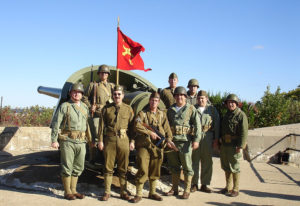
Battery Gunnison’s 6-inch gun with AGFA gun crew
Preservation Alert!! Crisis at Fort Wool Virginia. See the CDSG Save Fort Wool webpage for details: https://cdsg.org/savefortwool/
The Preservation and Interpretation Committee is charged with focusing CDSG’s efforts in preservation and assisting other organizations in preserving and interpretation important coast defense sites and artifacts. The committee’s missions are:
- This committee is the focal point for members to pass information on threats to coast defense sites, to seek support from the CDSG in their efforts to preserve a site.
- The committee will insure that preservation issues will be fully considered and presented to the Board before any official CDSG position is taken.
- The committee will also provide assistance or information to other organizations seeking to restore and interpret coast defense sites.
- The committee also represents the CDSG as a consulting party under the federally mandated Section 106 process.
The committees ongoing activities are:
- The committee shall make reports to the membership on its activities and efforts at the Annual Business Meeting and in the quarterly CDSG newsletter.
-
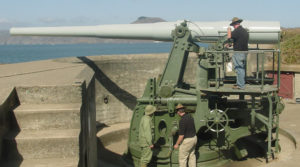
Battery Chamberlin’s 6-inch DC with CDSG gun crew
The committee will communicate the official position of the CDSG and its Board on preservation and interpretation issues to site owner and other interested parties.
- The committee will keep a list of current preservation efforts and seek to assist those efforts.
- The committee will establish a database of coast defense sites and their current owners. This database will be used to educate the owners of the value of preserving the coast defense structures and artifacts.
The committee hears every year about one or more site issues that they then never hear any follow-up on. The committee chairman would strongly encourage anyone who reads about such an issue, and who knows what the resolution of that issue was, to please let the committee chairman know so we can take action. The committee also works with the CDSG Fund to provide financial help with preservation and interpretation projects. If you have a preservation issue or question, or for further information on any of the items I have mentioned, contact the Preservation Committee Chair, Gordon Bliss, at preservation@cdsg.org.
Action items on this page: 1) Most Endangered and Best Preserved Sites, 2) Donation of Collections, 3) Fortification Preservation Guidelines (Scroll down for more details)
1) CDSG Most-Endangered and Best-Preserved Sites Lists 2024
The CDSG has assembled lists of the American seacoast defense sites that are being threatened with destruction by neglect or development as well as sites where preservation efforts have been highly successful. We plan on updating these lists periodically. Please click the links below to download the illustrated lists. Endangered List Updated July 23, 2024.

Most Endangered Coast Defense Sites
Outstanding Preserved Coast Defense Sites
List of Restored Sites to visit and sites with Lodging
Coalition for the Restoration of Fort Wool Virginia: Click here for Save Fort Wool – fact sheet PDF
2) Donation of Coast Defense Collections to the Fort Monroe Authority Casemate Museum
Terry McGovern – CDSG Secretary
The Coast Defense Study Group (CDSG) and the Fort Monroe Authority Casemate Museum (FMA) have agreed to work together to provide a permanent repository where CDSG members can donate their coast artillery/defense collections (artifacts, books, photographs, documents, etc.). The CDSG Board has approved this arrangement between the CDSG and FMA as it provide a possible solution to what has been an ongoing issue for our CDSG members and their families. We have summarized below the rationale, responsibilities, and process for the donation of these materials to the FMA for research and use by future generations. CDSG_Special Collection_MOU_FMA_Casemate document
Responsibilities
The CDSG will assist members with complying with the FMA Casemate Museum’s collection policies and procedures.
The CDSG does not accept or assume any liability for the copyright or ownership status of any donated material, that responsibility remains with the donor.
The FMA Casemate Museum’s archives are professionally organized and maintained in a secure facility and is governed by Fort Monroe Authority and follows the guidelines set forth in their formal Collections Management Policy.
The FMA Casemate Museum will maintain any accepted materials and preserve them for future generations. The FMA Casemate Museum reserves the right to decide which collections will be accepted.
FMA Casemate Museum will make the donated materials available for viewing and research once the collection has officially been processed.
Process
Below are the steps involved and the attached are samples of the paperwork need to donate materials to the FMA Casemate Museum:
- Contact the FMA Casemate Museum collections staff to discuss your interest in donating to the CDSG Special Collection (Chelsea Morris, Collection Specialist, cmorris@fortmonroe.org (757)-690-8065.) They will send you a History of Artifact This questionnaire will assist the collection staff to assess the items you which to donate to the special collection. An example of this form is attached to the memo.
- Fill out this form to the best of your ability. Email or mail the completed form along with several photographs of the coast artillery materials to FMA Casemate Museum collection staff. If you have several boxes of materials, please discuss directly with the collection staff.
- The FMA Casemate Museum collection staff will contact the donor within 30 days of receipt to acknowledging the donor’s paperwork and to let them know if they should ship the material to the FMA Casemate Museum, as well as letting them know to who, how, and where they should ship the materials. The collection staff will provide a Temporary Artifact Receipt form to the donor when they receive the coast defense material.
- The museum collections team will meet quarterly to discuss any potential acquisitions. Should the museum decide to accept the donation, a collections staff member will be in touch to arrange for an official Deed of Gift form to be signed. If the museum decides not to accept the materials, a staff member will work with the donor to arrange for the return of the items, and paperwork to acknowledge the return.
An example of this paperwork listed above: CDSG_Special_Collection_MOU_FMA_Casemate.pdf
3) Fortification Preservation Summary Guidelines
Over the past several years owners of former seacoast fortification sites have reached out to the Coast Defense Study Group (www.cdsg.org), especially our CDSG Representatives, seeking advice on actions they can take to stabilize and preserve the former fortification structures which they own or control. The CDSG has preservation manuals (produced by NPS and Washington State Parks) that provide instructions on how to preserve and restore fortification structures from the masonry era to the reinforced concrete period. While it would be great if owners followed all the great instructions provided in these manuals, many times their limited resources result in no actions at all. To help site owners focus limited resources on a few key regular actions we have summarized critical guidelines for them below. Please share this advice with your site owners in your local area or when you are visiting these former fortifications. If these actions are not undertaken on a regular basis these structures will become ruins and eventually disappear. The guidelines are listed below, a PDF version of these guidelines can be downloaded from this link: CDSG Fortification Preservation Guidelines (PDF)
Seacoast Fortifications Preservation Manuals
These details provided here are only a general summary of some of the recommendations covered in the manuals listed below. It is strongly advised that they be consulted for further details. They also list a number of other resources with more information on specific topics. PDF version of these manuals are available for download here.
Historic Preservation Fortification Handbook (Washington State 2003)
Seacoast Fortifications Preservation Manual (Golden Gate Nat. Rec. Area, 1999)
Stabilization and Preservation of DoD-owned Military Fortifications (DOD Legacy Resource Management Program PROJECT 05-239, 2006)
Landscaping and Vegetation Removal
Roots can cause significant damage to seacoast fortifications by destroying the structure and allowing water penetration. They need to be controlled. Do not pull out roots that have already worked into the structure. Cut large plants at ground level and let the roots deteriorate. Stumps can be treated with an appropriate herbicide. In general, all woody vegetation growing within four feet of a concrete structure should be removed, while all vegetation growing on the concrete or masonry structures should be removed. Woody vegetation larger than four inches in diameter should be removed from all manmade engineered slopes. This also restores the original context of the structure for interpretation.
Ground cover or other native plants help prevent soil erosion. Grass can be used but requires more maintenance and care must be taken with mowing equipment to ensure structures are not inadvertently damaged. In some cases, the army used goats and sheep to keep vegetation down when they controlled these military reservations.
Areas of a structure that were originally earth covered – such as the front of gun batteries – should remain covered. If excavation is necessary for repair or other reasons, the earth should be replaced.
Structure Maintenance
The focus for this section is on concrete structures, though some advice is also valid for brick and stone. Detailed advice for all types of structures is given in the two manuals mentioned below.
Patching areas where concrete has spalled, been chipped off, or broken loose will prevent water infiltration further into the concrete and further deterioration. Replacement concrete should duplicate the old in composition, strength, color, and texture as much as possible. Detailed patching techniques are given in the Preservation Handbook listed below.
Cracks can be either dormant or active. Dormant cracks were caused by shrinkage during concrete curing and are not usually a cause for concern except for water infiltration. Active cracks – those that show movement over time – are the main issue and can indicate serious problems. There are a number of treatment options depending on the size and nature of the crack and the manuals referred to below should be consulted for further details. Treatment of large structural cracks should be determined by a structural engineer. Infiltration of water is a primary concern, particularly in areas with a freeze/thaw cycle, and steps need to be taken to minimize it.
Deteriorated concrete that has led to exposed metal reinforcement needs to be cleaned and a protective coating applied to prevent further corrosion, or repair/replacement if the structural integrity is threatened; before patching the area. If ignored, corroded metal will spread and break apart concrete.
For external metal parts, do not paint brass, bronze, wrought iron, or cast iron. There are protective coatings that can be used on these. Steel needs to be thoroughly cleaned down to bare metal before priming and painting.
For graffiti, do not use abrasive removal methods or chemicals that may attack the underlying material. The preferred methods to use will vary depending on the method used to create the graffiti. A table in the Preservation Handbook details the preferred methods for different types of graffiti.
Proper Drainage
Water infiltration is a major problem. Original drain systems have often failed and should be cleaned out and damaged components replaced with modern materials where they are not visible, such as sub-surface pipes. Damaged areas of concrete where water can collect and pool need to be repaired. Debris and vegetation need to be removed where they contribute to water entering or accumulating in a structure. In general, all steps that can be taken to prevent the infiltration of water into the structure or the accumulation of standing water on the structure will contribute to its preservation.
Creating a waterproof membrane on or in the concrete itself can be done if other methods do not keep it clear of standing water. These types of treatments are covered in the manuals listed below.
Preservation Efforts at Fort Adams
Vegetation removal is an important part of preservation. Besides making it easier to view and appreciate the structures, it is important because long term unchecked vegetation can cause damage to the structures. Volunteer efforts can make a big difference in this, particularly where tight budgets limit what can be spent by the part a fort or structure is in. At Fort Adams a volunteer group meets on a semi-regular basis to work on vegetation removal. Click the link to download a document that shows a set of before and after views of vegetation clearing at Battery Bankhead/1870s battery and the advanced redoubt at Fort Adams: